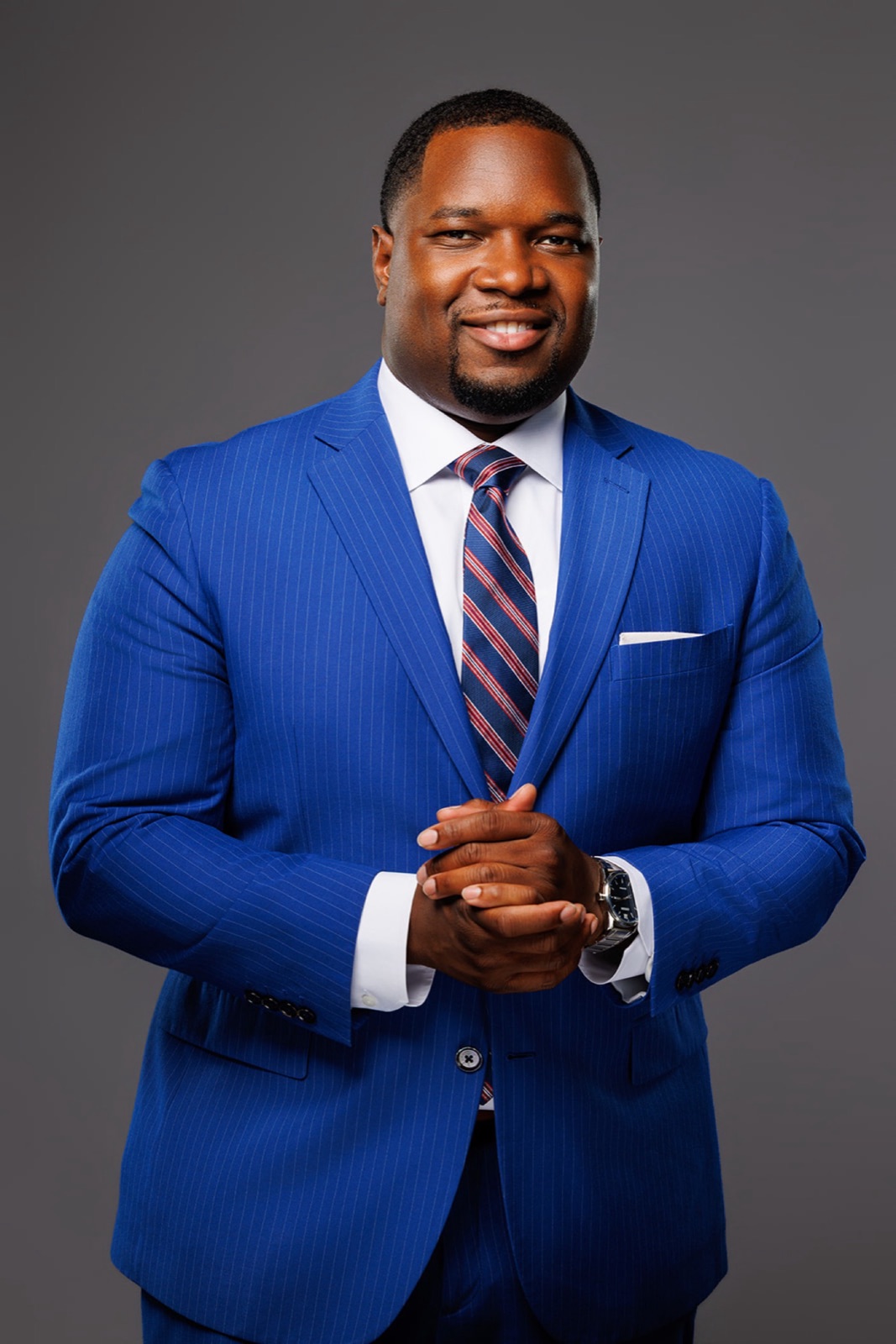

The civil rights and personal injury attorney discusses his humble beginnings, community-centered leadership and commitment to making justice more accessible.
By Tajala Kelly
For Attorney Brandon Price-Crum, practicing law is about far more than winning cases or securing major verdicts. It is a calling rooted in service, accountability and the belief that every person deserves to be heard.
At just 33 years old, Price-Crum has already built a growing career in civil rights and personal injury law while helping lead a firm with a staff of more than 50 employees and contractors. However, he says his larger purpose is to use his education, voice and position to improve the lives of others.
“The law is a calling,” Price-Crum said. “For me, it has also been a vehicle to do some of the dynamic work within the community and within society that I’ve always wanted to do.”
During a recent interview, Price-Crum spoke about his upbringing, his path into law, the responsibility of representing families during some of the most painful moments of their lives and the legacy he hopes to leave for the next generation.
A foundation built on service
Price-Crum comes from humble beginnings and credits his parents with teaching him the value of discipline, hard work and entrepreneurship.
Those lessons continue to shape the way he approaches his career and leadership.
He is also inspired by his family’s history. His great-grandfather began as a sharecropper and later became the first Black county commissioner in Butler County, Alabama. That journey showed Price-Crum what can happen when someone uses their position to create opportunities for others.
He also draws inspiration from civil rights leaders and attorneys such as Thurgood Marshall, who used the law to challenge discrimination and defend communities that had often been denied a voice.
Price-Crum said those examples remind him of the responsibility that comes with being an attorney.
Beyond his legal title, he describes himself as a father, community advocate and leader committed to leaving the world better than he found it.
“One of the things that is important to me is building institutions and building opportunities for others,” he said.
Discovering a path to law
Although Price-Crum was interested in attorneys from a young age, he did not personally meet a lawyer until his senior year of college.
Before then, much of what he understood about the legal profession came from watching attorneys on television. He was drawn to their ability to present arguments, defend others and speak for people during difficult moments.
His path became clearer when he received the opportunity to attend the Florida A&M University College of Law with scholarship support.
FAMU Law’s mission of using legal knowledge to serve the community deeply connected with him.
“It was not just about becoming a lawyer, making a bunch of money and going off into the sunset,” Price-Crum explained. “It was about using what you gained to go back into your community and make things better.”
That lesson became the foundation of his career.
Standing between a wrong and a remedy
Price-Crum has developed a name in civil rights and personal injury law, but he said his concern for justice extends beyond any one community or type of case.
He believes people can face unfair treatment because of their race, disability, income, background or access to resources. Regardless of those differences, he said the law should not treat their lives or their right to justice as less valuable.
“Lawyers stand in the gap between people’s life and their liberty,” he said. “Lawyers stand in the gap between right and wrong. Lawyers stand in the gap between a wrong and a remedy.”
For Price-Crum, that responsibility includes holding individuals, businesses, institutions and government agencies accountable when their actions harm others.
Depending on the case, a legal remedy may include compensation, court intervention or broader changes to the way an organization operates.
He does not want his work to stop at obtaining a settlement. When harmful systems or business practices contribute to an injury or death, he believes attorneys must also push for changes that may prevent another family from experiencing the same loss.
Meeting families on their worst days
Many of Price-Crum’s clients come to him after suffering a serious injury or losing someone they love.
Those families may be dealing with medical negligence, unsafe workplace conditions or another institutional failure. At the same time, they may be facing companies with significant money, influence and legal resources.
What families need first, Price-Crum said, is someone willing to listen.
“They want somebody who hears them,” he said. “They want somebody who is going to stand beside them through the process and guide them through the process.”
He described many legal cases as a David-versus-Goliath battle. On one side may be a grieving family with limited resources. On the other may be a powerful corporation, insurance company or government agency supported by experienced legal teams.
His role is to help ensure that the family is not reduced to a number or treated as though their loss does not matter.
“The human being cannot be replaced,” he said. “We cannot put a monetary value on the life of a human being and the impact that human being can make.”
Although financial compensation cannot undo a tragedy, the civil legal system can provide families with a remedy while forcing institutions to answer for harmful conduct.

Changing how people view personal injury attorneys
Price-Crum is aware that personal injury attorneys are sometimes described as “ambulance chasers” or accused of caring more about money than people.
He wants his leadership to challenge that image.
“I don’t chase any case,” he said. “A case that comes to me comes to me because a family is in need. It is the worst day of their life.”
Most personal injury attorneys work on a contingency basis, meaning clients do not pay an upfront consultation or representation fee. The attorney is generally paid only if the case results in a financial recovery.
Price-Crum said that model can provide access to justice for people who could not otherwise afford to challenge a well-funded institution.
His firm has also worked to address language and cultural barriers by hiring employees from different backgrounds who can communicate with clients in multiple languages.
He believes people should be able to understand their rights and the legal process regardless of the language they speak or the community they come from.
“There was a point where, as African Americans, we could not represent ourselves in a court of law,” he said. “There were laws being put in place that affected us, and we had no voice.”
For Price-Crum, building a diverse and client-centered firm is one way to ensure more people have that voice today.
Transparency, integrity and service-centered leadership
When clients work with Price-Crum, he wants them to know they have an attorney who will be honest about the legal process and fully committed to their case.
He identified transparency, determination and integrity as three of his core values.
“If I take on your case, I’m going to fight for you,” he said. “I’m going to stay up late nights. I’m going to stay up on weekends. I’m going to take time away from my family to focus on presenting the best case possible for you.”
He also believes leadership should be rooted in service.
Rather than standing above his team and giving commands, Price-Crum said he wants to be at the front, helping carry the same weight and moving toward the goal with them.
“My leadership style is that I’m at the front of the chariot, on the ropes, pulling it,” he explained. “You’re walking with me, and we’re walking together.”
That same approach applies to clients. He wants them to have the information and resources they need to make educated decisions about their cases.
Inspiring the next generation
Price-Crum’s definition of success extends beyond the number of cases he wins.
While successful cases are necessary to support the firm, its employees and its clients, he hopes his work also inspires young people to understand the power of education and the legal profession.
His six-year-old son has already expressed an interest in becoming an attorney.
Price-Crum hopes more young people—especially those from underrepresented backgrounds—will consider the same path.
“We need you to become a lawyer,” he said. “We need more voices. We need more diversity. We need more people who are passionate about different communities and different issues.”
Attorneys often become elected officials, policymakers, board members and leaders who help shape the rules governing communities. Price-Crum wants young people to recognize that a law degree can give them the skills to enter those spaces and influence decisions.
Once they reach those rooms, he said, they must be prepared to speak.
“You are not just sitting on the sideline hoping to get an opportunity,” he said. “Once you get in that room, once you get on that committee and once you get on that board, you have the power to say what needs to be said.”
The continuing fight for civil rights
When Price-Crum sees modern civil rights cases in the news, he often thinks about the activists and attorneys who fought similar battles decades ago.
He watches old interviews and documentaries and sometimes questions how much society has truly changed.
“We can watch documentaries from 50, 60 or 70 years ago, and we are still in the same fight today,” he said.
Although progress has been made, Price-Crum believes racism, classism and other forms of division continue to affect how people are treated.
He also worries that opportunities gained through the sacrifices of past generations may sometimes be taken for granted.
At the heart of the issue, he said, is whether society truly recognizes the humanity of people who look different, come from disadvantaged backgrounds or have fewer resources.
“To kill someone because they do not look like you, because they do not come from your community or because you fear what you do not understand is not the way we should operate today, tomorrow or at any point in the future,” he said.
That continued injustice is one reason he remains committed to civil rights work.
Carrying the emotional weight of the work
Representing families through grief and trauma comes with an emotional cost.
Price-Crum said caring for himself is both a spiritual and personal process. Prayer plays a major role, but he also values therapy, friendships, travel and time away from legal work.
“People don’t come to us on their best day,” he said. “They come to us on their worst day, and we have to shoulder that burden for them.”
Attorneys must sometimes carry the legal fight so families have space to grieve and care for one another.
To continue doing that work, Price-Crum believes lawyers must be intentional about protecting their own mental and emotional health.
He also acknowledged the pressure that can come with being a minority in the legal profession. Black attorneys may feel they must repeatedly prove their knowledge, professionalism and ability in spaces where people hold narrow ideas about what a lawyer should look or sound like.
Maintaining healthy outlets helps him continue showing up for his family, his staff and the thousands of clients his firm represents.
Building a legacy through the law
Price-Crum is a partner with the Serious Injury Law Group, which has offices in Montgomery and Birmingham, Alabama, as well as Atlanta and Thomasville, Georgia.
As his career grows, he wants to remain focused on the principles that brought him into the profession: service, justice, integrity and community.
His goal is not simply to be remembered for large settlements or high-profile cases.
He wants his legacy to reflect the people he helped, the institutions he challenged and the young people he encouraged to use their education as a tool for change.
For Price-Crum, the law is not only a career. It is a responsibility to stand between powerful institutions and the people who need someone willing to fight for them.
It is, as he describes it, an opportunity to stand in the gap.